


Quick Answer
HEPA-filtered hand dryers are sanitary for commercial use when they include true particulate capture and routine maintenance. Cleveland Clinic research confirms dryers don't create bacteria—they only move existing room air. True HEPA filtration traps 99.97% of particles at 0.3 microns. Touchless sensors, stainless steel housing, and antimicrobial coatings are non-negotiable features. Dry time stays under 12 seconds. TETCH, an ISO-certified OEM/ODM manufacturer supplying 100+ countries, builds units with HEPA filtration and 304 stainless steel housing as standard.
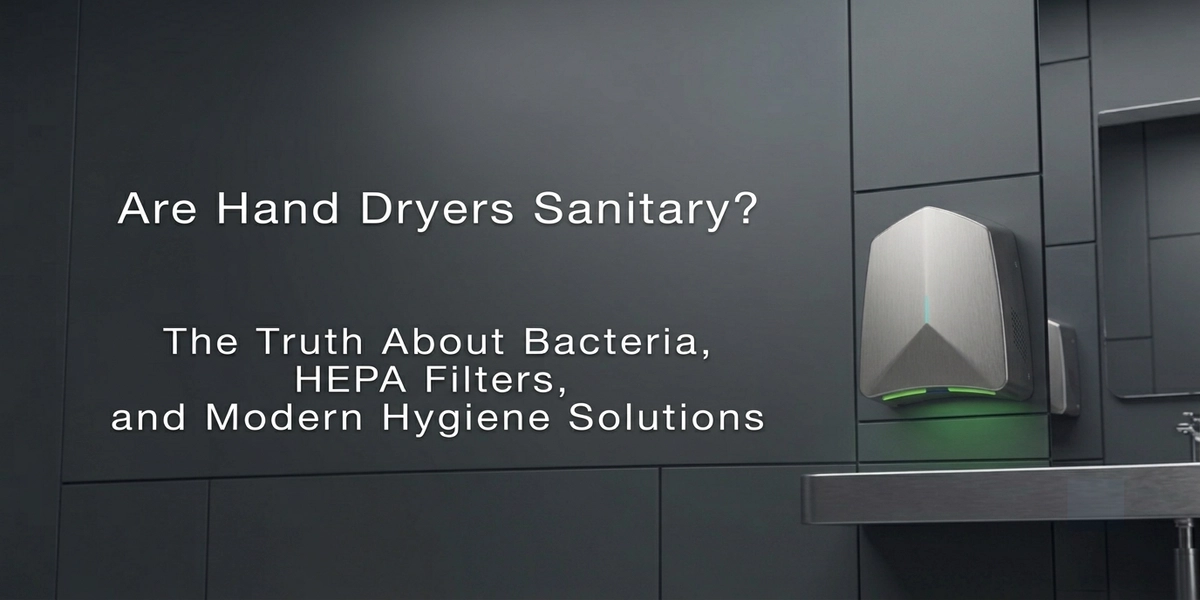
Modern HEPA-filtered hand dryers are sanitary for commercial use when they include true particulate capture and routine maintenance. Cleveland Clinic and Harvard Health Publishing research confirms that recirculated air movement — not the dryer itself — creates whatever bacteria risk exists. This breakdown separates outdated myths from the engineering standards that actually matter for high-traffic washrooms.
The Bacteria Concern — What the Research Actually Says
Cleveland Clinic researchers have documented how older, unfiltered dryers pull air directly from the surrounding washroom. Flush a toilet without closing the lid, and aerosolized particles hang in the air for several minutes. A dryer with no intake filtration can draw in that same air and blow it straight onto wet hands.
This is the root of most hand dryer bacteria concerns, and it’s legitimate for older equipment lacking proper intake design. Because of this, the real debate isn’t dryers versus towels — it’s proper intake design versus none. A dryer doesn’t manufacture bacteria; it only moves whatever air already exists in the room.
The stakes are practical, not theoretical. A hospital wing or a busy airport terminal can’t afford a failed infection-control audit over a $40 intake component. Facility teams that swap legacy dryers for properly designed units close that exposure permanently.
Hand Dryer vs Paper Towel — A Fair Comparison for Commercial Buyers
Paper towels win on raw friction. Rubbing a towel across skin physically lifts bacteria off the surface, and Harvard Health Publishing backs mechanical drying as effective when towels are fresh and dry. But friction isn’t the whole story in a washroom processing hundreds of visitors a day.
Overflowing bins become a secondary contamination source within hours of peak traffic. Someone has to empty them, restock them, and mop up whatever missed the bin. High-speed jet dryers remove moisture in under 12 seconds, and that speed matters because damp skin is where bacteria multiply fastest.
Neither format is inherently dirty. The variable is maintenance discipline — a starved dispenser and a dryer without proper filtration create the same kind of risk.
Waste handling separates the two formats further. A mid-size airport restroom can generate hundreds of pounds of used paper towels a week, all destined for landfill. Touchless dryers eliminate that stream entirely, which is why sustainability audits increasingly favor them for new builds and retrofits.
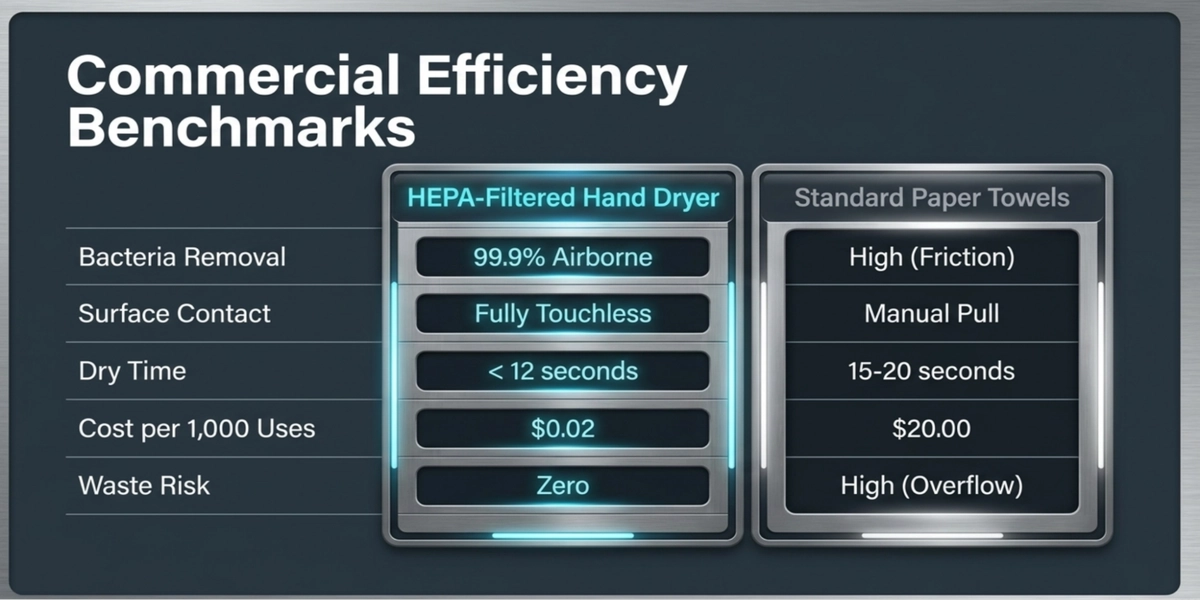
| Feature | HEPA-Filtered Hand Dryer | Standard Paper Towels |
| Bacteria Removal | 99.9% (airborne microbes) | High (mechanical friction) |
| Surface Contact | Fully touchless (infrared sensor) | Manual pull / dispenser |
| Dry Time | Under 12 seconds | 15–20 seconds (proper technique) |
| Waste Risk | Zero maintenance waste | High (overflowing bins) |
| Cost Per 1,000 Uses | Approximately $0.02 | Approximately $20.00 |
| Maintenance | Periodic filter check | Constant restocking |
How HEPA-Filtered Hand Dryers Solve the Hygiene Gap
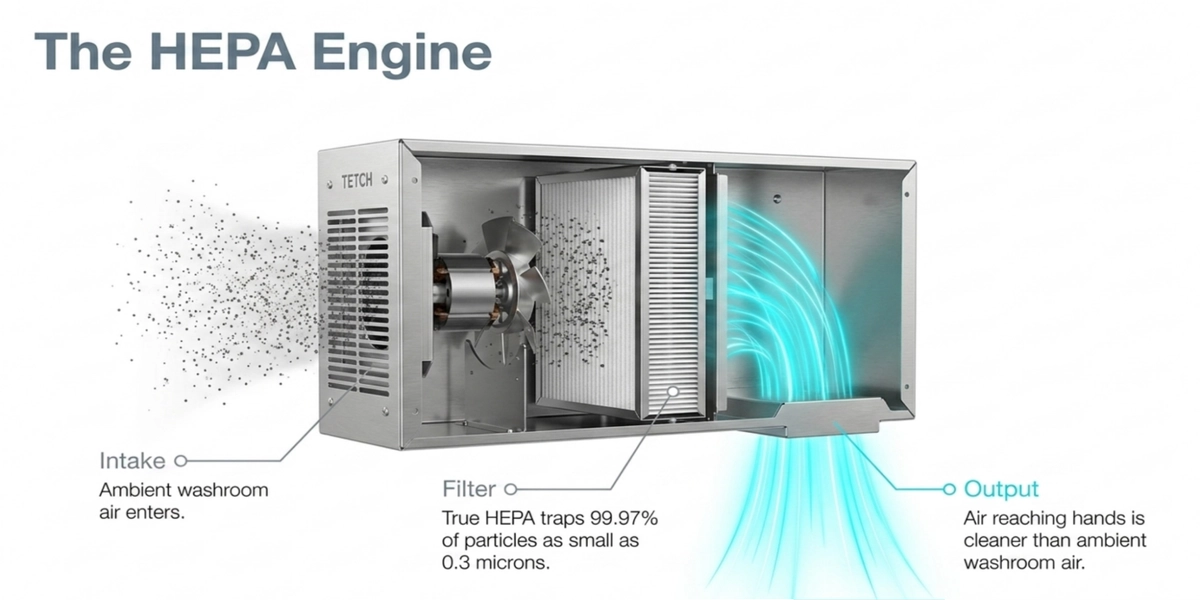
This is where the sanitary performance of hand dryers actually gets decided. HEPA (High-Efficiency Particulate Air) technology traps 99.97% of particles as small as 0.3 microns before that air reaches a user’s hands, which is why hospitals and food processing plants specify these systems over open-intake designs.
That single design choice stopped being optional once commercial-grade units adopted it as standard. Output air is frequently cleaner than the ambient air surrounding it.
Key Hygiene Features to Look For in a Commercial Hand Dryer
Buyers asking are hand dryers hygienic enough for their facility should evaluate four things first. Skipping any one of them shifts risk back onto the maintenance team.
- Touchless, sensor-triggered operation — eliminates buttons that harbor germs between cleanings.
- True HEPA filtration — not a coarse intake screen marketed under the same name.
- 304 stainless steel housing — sanitizes faster than painted plastic and resists corrosion in humid, high-traffic restrooms.
- Antimicrobial surface coating — inhibits mold and mildew growth on the outer casing.
None of these features work in isolation. A stainless unit with a weak sensor still gets touched, and a filtered dryer with plastic housing still harbors grime over time. Specify all four together, and the maintenance burden drops instead of shifting elsewhere.
Hand Dryer-K1003
Hand Dryer-K1003 Automatic, entry level hand dryer designed for small or low use washrooms offering excellent value and good performance at a price that suits smaller budgets.
View More Details
Tetch Hand Dryers — Built for Hygienic, High-Traffic Washrooms
TETCH has manufactured washroom hygiene equipment since 2000, running nearly 48,000㎡ of production floor under an ISO9000-certified quality system. The defect rate sits below 0.1%, which matters when a single faulty sensor can take a restroom bank offline during peak hours.
The catalog spans over 200 dryer models, including Ultra High-Speed and Jet Hand Dryers built for airports, malls, and transit hubs. Every unit pairs touchless sensor activation with HEPA filtration and available 304 stainless steel housing — the same three features this article just outlined as non-negotiable. An in-house R&D team holds 100+ design patents and has picked up iF and Red Dot recognition along the way.
Custom configurations extend beyond standalone dryers to All-in-One Tap systems for buyers consolidating washing and drying into a single touchless fixture. Every installation cuts water, paper, and energy costs simultaneously, which shows up directly in facility utility bills and sustainability reporting.
Projects move fast: 72-hour prototyping and 25–40 day lead times keep installation schedules on track. A 21-member sales team supports OEM and ODM buyers closing the hand dryer hygiene gap for high-traffic facilities, backed by a catalog of 1,500+ proven product models.
Frequently Asked Questions
Do Hand Dryers Spread Bacteria?
Hand dryers do not spread bacteria when they include true particulate filtration and receive regular maintenance. Older units without proper intake design can recirculate ambient washroom air, which carries airborne particles onto wet hands. Modern jet dryers with HEPA technology trap 99.9% of those particles first, putting them on par with paper towels for everyday hygiene.
Is a Hand Dryer Sanitary Enough for Hospitals and Food Facilities?
Yes, provided the unit includes true HEPA capture and a stainless steel housing that withstands frequent sanitizing. Standard, unfiltered dryers fall short of healthcare and food-service requirements, which is why regulators increasingly specify these treated-air, touchless systems.
How Often Do Hand Dryer Filters Need Replacing?
Most commercial filters need inspection every three months and replacement every 6–12 months, depending on foot traffic. High-traffic locations like airports or stadiums should schedule quarterly checks.


